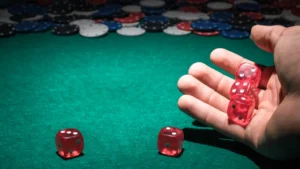
Craps tables are the loudest spot on any casino floor, with players shouting and cheering together. The game looks complicated at first, but it becomes simple once you learn the basic bets and rules. The best craps strategy is to stick with low house edge bets like the Pass Line (1.41% house edge) and Come bets while avoiding risky proposition bets in the middle of the table.
You don’t need to memorize every bet to start playing and winning. Most successful players focus on just a few smart bets that give the casino less advantage. This approach keeps the game simple and your money lasting longer.
This guide breaks down everything you need to know to play craps with confidence. You’ll learn how the table works, which bets to make, and how to use proven strategies that actually help your odds.
Essential Craps Rules and Table Layout
The craps table has distinct betting areas where you place chips based on different outcomes. The game moves through phases controlled by the shooter’s dice rolls, with specific numbers triggering wins or losses depending on your bets.
Understanding the Craps Table
The craps table is a large felt surface with three main sections. The center area holds proposition bets, while identical betting zones appear on both ends for player access.
You’ll find the Pass Line running along the outer edge where most players start. The Don’t Pass bar sits just above it. The Field section takes up space in the middle of each end section.
Numbers 4, 5, 6, 8, 9, and 10 have boxes across the top. These are the Point numbers. The Come and Don’t Come areas sit between the Pass Line and Field.
Each table seats up to 12 players. Two dealers manage bets on each end while a stickman controls the dice in the center. A boxman supervises the game between the two dealers.
Basic Rules of Craps
The shooter (dice roller) starts with a Come Out roll. If you roll 7 or 11 on this first roll, Pass Line bets win immediately. Rolling 2, 3, or 12 means Pass Line bets lose right away.
Any other number (4, 5, 6, 8, 9, or 10) becomes the Point. The dealer marks this number with a puck. You now roll until you hit the Point number again or roll a 7.
Rolling the Point before a 7 wins the round. Rolling a 7 before the Point ends the round and passes the dice. This is called sevening out.
You must bet the table minimum to shoot dice. Most players choose the Pass Line for this bet.
Types of Bets and Payouts
Pass Line pays 1:1 and is the most common bet. You win on Come Out rolls of 7 or 11, then win if the Point hits before a 7.
Don’t Pass also pays 1:1 but bets against the shooter. You win on Come Out rolls of 2 or 3, lose on 7 or 11, and push on 12.
Come bets work like Pass Line bets but start after the Point is set. Don’t Come bets mirror Don’t Pass bets with the same timing.
Odds bets have no house edge and pay true odds. You place these behind your Pass Line or Come bets. They pay 2:1 on points 4 and 10, 3:2 on 5 and 9, and 6:5 on 6 and 8.
Place bets let you bet on specific numbers. These pay 9:5 on 4 and 10, 7:5 on 5 and 9, and 7:6 on 6 and 8.
Field bets are one-roll bets covering 2, 3, 4, 9, 10, 11, and 12. They typically pay 1:1, with 2:1 on 2 and 12.

Winning Craps Strategies for Casino Play
Smart craps players focus on bets with the lowest house edge, protect their bankroll through disciplined betting limits, and avoid common traps that drain their chips quickly.
Best Bets to Maximize Your Odds
The Pass Line bet is the foundation of solid craps strategy. This bet carries a house edge of only 1.41%, making it one of the best options on the table. You win if the shooter rolls a 7 or 11 on the come-out roll and lose on 2, 3, or 12.
After a point is established, you should take full odds behind your Pass Line bet. Odds bets have zero house edge, which means the casino has no mathematical advantage on this wager. Most casinos allow 3x-4-5x odds, though some offer higher limits.
The Don’t Pass bet offers an even lower house edge at 1.36%. This bet wins when the shooter rolls 2 or 3 on the come-out and loses on 7 or 11. Many players avoid this bet because you’re betting against the shooter, but it’s mathematically superior.
Bets to avoid include:
- Any 7 (house edge: 16.67%)
- Hardways (house edge: 9.09% to 11.11%)
- Field bets (house edge: 2.78% to 5.56%)
- Proposition bets (house edge: 11% to 16.67%)
Come bets work identically to Pass Line bets but can be made after the point is established. These bets also allow you to take odds and carry the same 1.41% house edge.
Bankroll Management Techniques
Set a specific dollar amount for your craps session before you start playing. Your bankroll should be money you can afford to lose without affecting your daily expenses.
A common rule is to bring at least 10 times your planned average bet. If you plan to bet $10 on the Pass Line, you should have at least $100 available. This gives you enough cushion to handle normal ups and downs.
Divide your total gambling budget into separate session bankrolls. If you have $500 for a weekend trip, split it into five $100 sessions. When one session bankroll is gone, walk away and wait for the next session.
Never chase losses by:
- Increasing bet sizes to recover money
- Withdrawing additional cash from ATMs
- Making high-risk proposition bets for quick wins
Track your wins during each session and set a win goal. Many experienced players pocket half their winnings once they double their session bankroll. This strategy ensures you leave the table with profit even if your luck changes.
Dice Control and Shooter Tips
Dice control involves a consistent throwing technique to potentially influence outcomes. While controversial and difficult to master, some players use a controlled grip and throw to reduce randomness.
The most common grip is the 3-V set, where you position the dice so three spots form a V pattern on top. You hold the dice between your thumb and forefinger with light pressure. The goal is a smooth, consistent toss that minimizes bouncing and spinning.
Your throw should be gentle with a slight backspin. The dice should land together, hit the back wall once, and drop with minimal tumbling. Practicing this technique takes hundreds of hours and may not significantly change the odds.
When you’re the shooter, stay relaxed and take your time. Rushed throws create erratic results. Some players believe setting the dice delays the game, but casinos allow it as long as you don’t slow play excessively.
Common Mistakes to Avoid
Many players spread their money across too many bets simultaneously. This strategy increases the total amount you have at risk and exposes you to higher combined house edges. Stick to one or two bets with the best odds rather than covering the entire table.
Betting on hunches or “hot” and “cold” tables is another common error. Each dice roll is independent, and past results don’t predict future outcomes. A table that hasn’t rolled a 7 in ten rolls isn’t “due” for one.
Drinking alcohol while playing impairs your judgment and leads to poor betting decisions. Casinos offer free drinks specifically because they know intoxicated players make mistakes and bet more aggressively.
Ignoring odds bets costs you money over time. Since odds bets have no house edge, failing to take maximum odds means you’re not getting the best possible return on your Pass Line or Come bets.
Some players increase their bets after losses, thinking they’ll eventually win and recover everything. This approach called the Martingale system, requires an enormous bankroll and often hits table limits before you can recover losses.